|
|
|
|
|
|
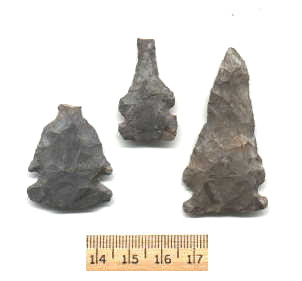
Port Maitland point that measured nearly 51 mm in length (Ritchie, 1994, Plate 82 figure 35), a very close match to my find. Reliable metric data for the Port Maitland type is seemingly unavailable due to the limited sample of these points (Ritchie, 1994). With this limitation in mind, I conducted the following experiment.
Not wanting to solely rely upon subjective visual comparisons to images of other Port Maitland points, I pushed the morphometric analysis of my find one step further. Using a computer program designed by Tara Prindle called POINT (1993, Vers. 1.0), I was able to compare my find's morphometric attributes to those stored in a database inclusive of the various point styles of the Northeast. Prindle's projectile point classification program uses Ritchie's projectile point descriptions and considers 14 distinct morphological attributes to assign a point type.
My initial sense was that the length of my point represented an aberration from the norm. It was apparent to me that if the blade aspect of the artifact was less lengthy that it would be a proximate match for a Port Maitland point. Out of curiosity I entered a value of 26 mm in the data field for point length rather than the actual value of 52 mm, surmising that this adjustment would result in a confirmation of a Port Maitland type determination. As predicted, the Point program confirmed a Port Maitland type assignment. Having input morphometric
|
|
|
|
|
|
|
|
|
|
|
values in each of eight user defined data fields exactly as required, save one, the program indicated that the point was a match to the Port Maitland type within one standard deviation.
This situation should serve to remind collectors that no two projectile points of a given type are ever exactly alike. Points with rather striking variations can appropriately fall into the same typological classification. Consideration must be given for some degree of variation from what we recognize as "classic" type attributes. In the instance of the point described here, a significant variation in length may have initially given me pause to reconsider an accurate type assignment. I posit a single, plausible reason for this point's "lengthy" departure from the stylistic norm. Perhaps many of the Port Maitland samples used to define the morphometric profile of the type were re-sharpened, resulting in a significant reduction in original length. There is of course the possibility that this more lengthy variant is simply an abberation. Given that the basal treatment of a projectile point is often the single most important factor in determining appropriate type, I am confident that a Port Maitland assignment is fitting in this case. It should, however, be noted that a professional archaeologist in Ontario, Canada has expressed an opinion that this point is representative of a style that has been termed Nanticoke Notched in Ontario typologies. It is my sense that the two types are very closely related in style and
|
|
|
|
|
|
|
|
|