Late Woodland stages that is not well established in the literature that I have reviewed.  The presence of a Port Maitland (Raccoon or Nanticoke Notched) style arrow point confirms a presence  on the riverine site by cultures beyond the Early Woodland Meadowood for which it is so well known.


REFERENCES

Braun, David P. and Braun, Esther K.  1994.  The First Peoples of the Northeast.  Moccasin Hill Press.  Massachusetts.

Granger, Joseph E.  1978.  Meadowood Phase Settlement Pattern in the Niagara Frontier Region of Western New York State.  Museum of Anthropology, University of Michigan  NO. 65.

Justice, Noel D.  1987.  Stone Age Spear and Arrow Points of the Midcontinental and Eastern United States:  A Modern Survey and Reference.  Indiana University Press.  Indiana.

Morgan, Louis H.  1962.  League of the Iroquois.  The Citadel Press.  New Jersey.

Ritchie, William A.  1994.  The Archaeology of New York State.  Purple Mountain Press. New York.

Ritchie, William A.  1989.  A Typology and Nomenclature for New York Projectile Points.  New York State Museum
Bulletin Number 384. 

Zubrow, Ezra and Buerger, Paul.      1994. The Martin Site of Grand Island. Journal of World Anthropology I (1).

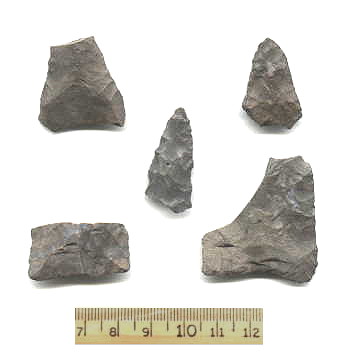
Fig. 6
Levanna point fragments, top left and right

    In addition to the classic Early Woodland Meadowood quaternary  blank, or cache blade, fragments pictured at lower left and right in figure 6, I have also recovered fragments of point styles that would be consistent with Late Woodland cultural occupations.  The two fragments pictured at top left and right in figure 6 are broken Levanna points that are lithic hallmarks of a later pre-Iroquoian Owasco influence that would eventually come to dominate much of New York.

g

6

[RETURN TO TABLE OF CONTENTS]