|
|
|
|
|
|
were interesting my passion has always been for lithics, particularly projectile points, and I was hopeful that in time this site would yield a complete find for my efforts.
After a couple more visits it became disappointingly clear to me that this site was being surface collected by other artifact collectors such as myself. It should not have come as a surprise given the degree to which the site had been documented in major works on New York state prehistory. I realized that if I was going to stay ahead of the competition I would have to search where most would prefer not.
I quickly committed myself to crawling on my hands and knees on most occasions in order to peer beneath the dense overhanging brush and into dark undercuts. These hollow spaces were often a tangle of roots and debris that had been driven there by the intermittent heavy wave action of the river.
My determination paid off one day in April as I recovered a
|
|
|
|
|
|
|
|
|
|
|
complete projectile point from beneath one such undercut. I was on all fours and crawled as far forward into an eroded cavity as the root structures would allow. I could just barely discern the artifact's outline in the relative darkness. My shoulders strained at the encumbering roots as I stretched out an arm to retrieve my prize.
I have found quite a few whole points throughout the many years I have surface collected, but I can honestly say that for this one I have never worked harder. I was astonished that this delicate, complete projectile point had somehow survived centuries of perpetual abuse at the hands of the river and the harsh upstate New York elements. More amazing yet was that this point was laying exposed about one foot from the waterline when it was recovered. Had two or three larger waves made their way into that undercut, the point would likely have quietly slipped back beneath the sand and water for an untold number of years.
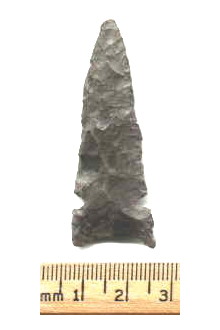
The point (Fig. 4) measures 52 millimeters in length by 20 millimeters at its widest point at the base. The point was neatly side notched to a depth of 2 millimeters on each side. A very thin point, it measures no more than 4 millimeters in thickness. The lateral sides of the base are squared yet the point displays one attribute that is somewhat atypical for the Meadowood points that are most often associated with this site.
Most classic Meadowood points have bases that vary from
|
|
|
|
|
|
|
|
|
|
|
convex to straight. This point displayed many of the typical morphological attributes of a Meadowood point save the markedly concave nature of its base. The concavity measures a full 2 millimeters. I was drawn to consider the possibility that this find was representative of some other type. Some collectors to which I initially showed the point immediately remarked "Otter Creek". The profile of the base is close but the point was just far too thin and delicate to qualify as any variation of an Otter Creek.
During May of 1999 I had occasion to meet with Gary Fogelman, Indian Artifact Magazine editor, at a small artifact show in Western New York. I showed Gary the point and described the site from which it came. We briefly discussed the possibility of the point being a lengthy Port Maitland or perhaps a Raccoon Notched point.
Subsequent reviews of scarce specimens, photographs and descriptions of Port Maitland style projectile points has led me to believe that this find is best classified amongst them. Images of what Ritchie originally called "Raccoon Notched" points with squared tangs and concave bases have been documented in collections from Port Maitland in Welland County, Ontario (Ritchie, 1994, Plate 81, figures 27, 30, 31, 35, 36). This particular site is associated with the Kipp Island phase in New York and is located approximately 45 miles from the site on which my find was made. Of particular interest to me was a
|
|
|
|
|
|
|