|
|
|
|
|
|
|
|
|
|
|
|
|
|
|
|
|
|
|
|
|
|
|
|
|
|
|
|
|
|
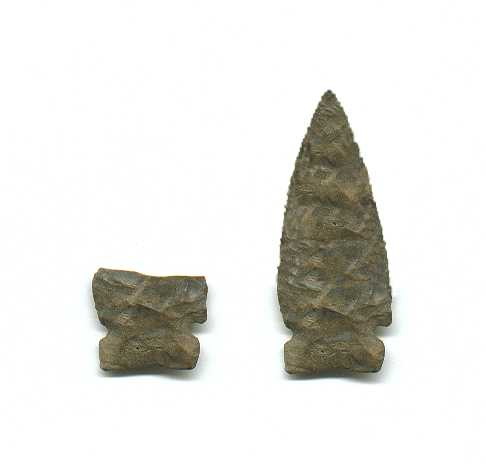
Meadowood points. Justice (1987) offers a length range for this point type of 41.28 to 88.9 millimeters. This range is based upon morphometric data taken from other Meadowood points from New York as collected by Ritchie (1989:35).
My initial visit to the Riverhaven site was brief. Other portions of the site would eventually become accessible but upon my first visit they were under a considerable amount of low brush overgrowth, whose minimal shade had effectively preserved sizeable patches of ice and snow cover. Some very thin strips of dry gravelly shoreline were clearly visible under the brush but as I had left my waders at home, I was ill-prepared to clamor about in the shallow water to probe beneath the undercut bank and tree roots where artifacts might be seen.
|
|
|
|
|
|
|
|
|
|
|
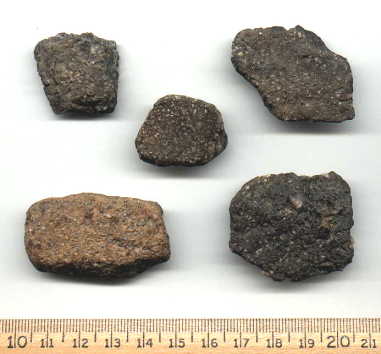
I have since returned to this site perhaps as many as a dozen times over the past couple of years and have continued my own personal reconstruction of the Meadowood past based upon the fragments of history I have been able to recover. Another type of artifact that has a strong diagnostic affiliation with Meadowood sites are potsherds. I have been fortunate to surface collect several fragments of ceramic material from this site (Fig. 3). Though none are in excellent condition due to the constant weathering to which they were exposed, three of the larger potsherds do exhibit the types of decorative cord markings that are diagnostic of Vinette I pottery. This same style of ceramic ware has been recovered on other documented Meadowood sites in New York state. Though the pottery finds
|
|
|
|
|
|
|
|
|
|
|
|
|
|
|
|
|
Fig. 2
Meadowood point fragment and virtual reconstruction
|
|
|
|
|
|
|
|
|
|
|
|
|
|
|
|
|
|
|
To say that this site held great promise for finding some artifacts would be an understatement.
There really wasn't much exposed beach to be examined on that first outing but the quantity of flakes I encountered made the task rather arduous. I found myself hunched over, quite a bit beyond the degree of my normal surveying posture, in order to better discern artifact from waste flake. It wasn't long before my back began to ache but I was rewarded with my first find at this site. Nestled against the edge of the frozen black muck was the small, broken base of a Meadowood point. The fragment measured a little more than 20 millimeters in width with a squared base and very shallow side notches that measured approximately 1.5 millimeters in depth. Based on a virtual point restoration (Fig. 2) I later created from this fragment, I surmised that the complete point may have measured nearly 50 millimeters in length. A comparison of these morphometric attributes places this artifact in the smaller range of
|
|
|
|
|
|
|
|
|
|
|
|
|
|
|
|
|
|
|
|
|
|
|
|
|
|
|
Fig. 3
Some examples of the Vinette I style potsherds recovered at Riverhaven
|
|
|
|
|
|
|
|
|
|
|
|
|
|
|
|
|
|